1. Meaning of number bases
A number base is the number of different digits used to represent numbers in a number system.
The decimal system we use every day has base 10, while computers commonly use the binary system, which has base 2.
The main number bases you should know for WASSCE are:
| Number System |
Base |
Digits Used |
| Binary |
2 |
0, 1 |
| Ternary |
3 |
0, 1, 2 |
| Quinary |
5 |
0, 1, 2, 3, 4 |
| Octal |
8 |
0–7 |
| Decimal |
10 |
0–9 |
| Duodecimal |
12 |
0–9, A, B |
In base 12,
A represents ten and
B represents eleven.
Important rule: In a base
b, the allowed digits range from 0 to
b-1. For example, the digit 2 cannot appear in a base-2 number.
2. Place value in different bases
In base 10, each position represents a power of 10.
For example:
4,372 = 4 \times 10^3 + 3 \times 10^2 + 7 \times 10^1 + 2 \times 10^0
Similarly, in base 2, each position represents a power of 2.
Consider
1011_2:
| Digit |
Place Value |
Product |
| 1 |
23 = 8 |
8 |
| 0 |
22 = 4 |
0 |
| 1 |
21 = 2 |
2 |
| 1 |
20 = 1 |
1 |
Therefore,
1011_2 = 8 + 0 + 2 + 1 = 11_{10}.
The small number written below a numeral is called its base indicator. Thus,
1011_2 is a binary number, while
1011_{10} is a decimal number.
Remember that any non-zero number raised to power zero is 1.
3. Converting numbers from another base to base 10
To convert a number to decimal, multiply each digit by its corresponding place value and add the results.
Example 3A:
Convert 2314 to base 10.
Step 1: Write the place values.
231_4 = 2 \times 4^2 + 3 \times 4^1 + 1 \times 4^0
Step 2: Evaluate.
=
2 \times 16 + 3 \times 4 + 1 \times 1
= 32 + 12 + 1
= 45
10
Example 3B:
Convert 110102 to base 10.
11010_2 = 1 \times 16 + 1 \times 8 + 0 \times 4 + 1 \times 2 + 0 \times 1
= 16 + 8 + 0 + 2 + 0
= 26
10
WASSCE tip: Always begin from the right-hand side, where the place value is
b^0 = 1
4. Converting decimal numbers to another base
Use the repeated division method for whole numbers.
Divide the decimal number by the new base repeatedly, recording each remainder. Read the remainders from bottom to top.
Example 4A:
Convert
25_{10} to base 2.
25 ÷ 2
Quotient = 12
Remainder 1
12 ÷ 2
Quotient = 6
Remainder 0
6 ÷ 2
Quotient = 3
Remainder 0
3 ÷ 2
Quotient = 1
Remainder 1
1 ÷ 2
Quotient = 0
Remainder 1
Read the remainders upwards: 11001
Therefore,
25_{10} = 11001_2
Example 4B:
Convert
47_{10} to base 5.
- 47 ÷ 5 = 9 remainder 2
- 9 ÷ 5 = 1 remainder 4
- 1 ÷ 5 = 0 remainder 1
Reading upwards gives
142_5
Check:
1 \times 25 + 4 \times 5 + 2 = 47
5. Converting from one non-decimal base to another
The safest method is to convert through base 10.
Example 5A:
Convert
132_4 to base 3.
Step 1: Convert to base 10.
132_4 = 1 \times 16 + 3 \times 4 + 2
= 16 + 12 + 2 = 30
Step 2: Convert
30_{10} to base 3.
-- 30 ÷ 3 = 10 remainder 0
-- 10 ÷ 3 = 3 remainder 1
-- 3 ÷ 3 = 1 remainder 0
-- 1 ÷ 3 = 0 remainder 1
Read upwards:
1010_3
Therefore,
132_4 = 1010_3
6. Arithmetic in different bases
You can add, subtract, multiply and divide numbers in any base. The key is to remember that carrying and borrowing depend on the base.
A. Addition
Example 6A:
Evaluate
1011_2 + 110_2
Write the numbers in columns:
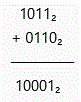
Explanation:
- Rightmost column: 1 + 0 = 1.
- Next column: 1 + 1 = 10 in binary. Write 0 and carry 1.
- Next column: 0 + 1 + 1 = 10. Write 0 and carry 1.
- Next column: 1 + 0 + 1 = 10. Write 0 and carry 1 to the next column.
Therefore,
1011_2 + 110_2 = 10001_2
Check in decimal: 11 + 6 = 17, and
10001_2 = 17_{10}
B. Subtraction
Example 6B:
Evaluate
1000_2 - 101_2
1000_2 = 8_{10} and
101_2 = 5_{10}
8 − 5 = 3, and
3_{10} = 11_2
Therefore,
1000_2 - 101_2 = 11_2
When borrowing in binary, 1 borrowed from the next column represents
10_2, which is two in decimal.
C. Multiplication
Example 6C:
Evaluate
101_2 \times 11_2
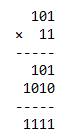
Therefore,
101_2 \times 11_2 = 1111_2
Check: 5 × 3 = 15, and
1111_2 = 15_{10}
D. Division
For division questions, you may convert both numbers to decimal, divide, and convert the answer back to the required base.
For example,
1100_2 \div 11_2 :
-- 1100_2 = 12_{10}
-- 11_2 = 3_{10}
-- 12 ÷ 3 = 4
-- 4_{10} = 100_2
Therefore,
1100_2 \div 11_2 = 100_2
7. Fractions in number bases
Fractional digits follow negative powers of the base.
For example, in base 2:
First digit after the point:
2^{-1} = 1/2
Second digit:
2^{-2} = 1/4
Third digit:
2^{-3} = 1/8
Example 7A:
Convert
10.101_2 to base 10.
10.101_2 = 1 \times 2^1 + 0 \times 2^0 + 1 \times 2^{-1} + 0 \times 2^{-2} + 1 \times 2^{-3}
= 2 + 0 + 0.5 + 0 + 0.125
= 2.625
10
Converting a decimal fraction to another base
Multiply the fractional part repeatedly by the new base. Record the integer part at each step, reading the integer parts from top to bottom.
Example 7B:
Convert
0.625_{10} to base 2.
- 0.625 × 2 = 1.25 → integer part 1
- 0.25 × 2 = 0.5 → integer part 0
- 0.5 × 2 = 1.0 → integer part 1
Therefore,
0.625_{10} = 0.101_2
Some fractions terminate in one base but repeat indefinitely in another.
8. Finding an unknown base
WASSCE questions may ask you to determine the base of a number.
Example 8A:
If
23_b = 17_{10}, find
b
Expand the number:
--2b + 3 = 17
--2b = 14
--b = 7
Therefore, the base is 7.
Always check that the base is greater than the largest digit in the numeral. Since the numeral contains digit 3, base 7 is valid.
Example 8B:
If
121_b = 16_{10}, find
b
Expand:
--b^2 + 2b + 1 = 16
--b^2 + 2b - 15 = 0
Factorise:
--(b + 5)(b - 3) = 0
Thus,
b = -5 or
b = 3
A base must be a positive integer greater than 1, so
b = 3
9. Comparing numbers in different bases
To compare numbers written in different bases, convert them to the same base, preferably base 10.
Example 9A:
Which is greater,
10110_2 or
24_8?
Convert each to decimal:
--10110_2 = 16 + 4 + 2 = 22_{10}
--24_8 = 2 \times 8 + 4 = 20_{10}
Since 22 is greater than 20:
--10110_2 > 24_8
10. Common WASSCE examination traps
| TRAP |
CORRECT APPROACH |
| Using an illegal digit |
A digit must be less than the base |
| Reading remainders from top to bottom during integer conversion |
Read them from bottom to top |
| Forgetting place values |
Start with b0 = 1 on the right. |
| Carrying as if working in base 10 |
Carry when the column total reaches the base |
| Assuming every fraction terminates |
Some fractions repeat indefinitely |
| Accepting a negative base as an answer |
The base must be a valid positive integer greater than 1 |
| Giving an answer without its base indicator |
Write the base clearly, such as 1012 |
| Skipping verification |
Convert back to the original base or to decimal |
11. Quick revision summary
- Base to decimal: Multiply each digit by its place value and add.
- Decimal integer to another base: Repeated division; read remainders upwards.
- Decimal fraction to another base: Repeated multiplication; read integer parts downwards.
- One base to another: Convert through decimal.
- Addition and subtraction: Carry or borrow according to the base.
- Unknown base: Expand using powers of the unknown base and solve.
- Validity check: Every digit must be smaller than the base.
The most important skills for WASSCE are conversion between bases, arithmetic in different bases, fractional conversions and finding an unknown base. Practise these until you can perform the conversions accurately without a calculator.